Style guide
What Defines an Alpine Chalet Interior?
Long before “chalet style” meant ski-lodge decor, the heart of an Alpine house was one warm, paneled room. Its stove, bench, corner and ceiling still define the look.
Published October 16, 2026 · Alpine Chalet, Mountain Modern & Rustic
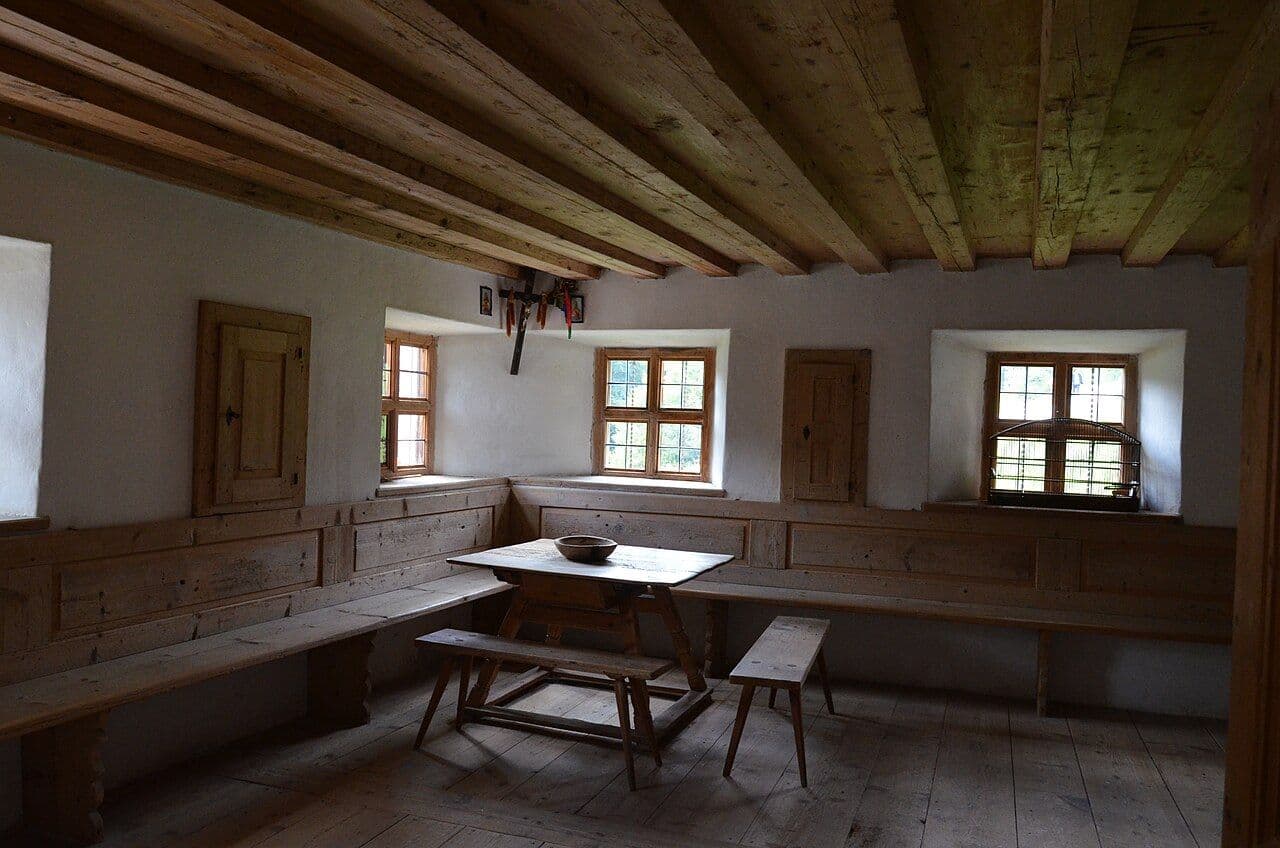
A historic Alpine chalet interior is defined by the Stube: the heated, wood-lined main room of a farmhouse or town house, warmed by a tiled or masonry stove, with a bench built along the walls, a table in the corner and, in Catholic regions, a crucifix corner called the Herrgottswinkel above it. Paneled walls, wooden ceilings, painted chests and cupboards and modest carving complete the picture. Much of what is sold today as chalet style is a later revival, shaped by 19th-century romanticism and by the holiday house.
The Stube: one warm room
Stube simply means a heated room. The word goes back to Old High German stuba and is related to the English stove; it distinguished the heated living room from an unheated chamber. In a traditional farmhouse the Stube was often the only room that could be heated in winter, so it served as living room, workroom and the place to receive visitors, and the sick were nursed there because it was warm. Stuben also became more common in Central European towns from the 13th century.
- Stube
- The heated main living room of an Alpine house; the word is related to the English stove.
- Kachelofen
- A stove built of glazed tiles, traditionally fired from the next room. Plastered masonry stoves served the same purpose.
- Ofenbank
- The bench built against or around the stove.
- Herrgottswinkel
- The “Lord God’s corner”: a crucifix corner above the bench and table in Catholic homes.
- Zirbe or Arve
- Swiss stone pine (Pinus cembra), a soft, aromatic wood used for paneling and furniture.
- Kerbschnitt
- Chip carving: geometric patterns cut by removing small chips with a knife.
- Bauernmalerei
- Literally “peasant painting”; today mostly revival and hobby painting in the folk manner.
- Chalet
- Originally a herdsman’s hut in the French-speaking western Alps; later a general word for a mountain or holiday house.
Rooms of this kind survive in museums across the region. The Tiroler Volkskunstmuseum in Innsbruck, opened in 1929 in a former Franciscan monastery, still shows fourteen historic Stuben from the Gothic period to the Rococo. The South Tyrolean folklore museum at Dietenheim displays a Stube from the Pifing farm in Hafling dated to the 14th century, and the open-air Museum Tiroler Bauernhöfe in Kramsach has re-erected farmhouses with their Stuben, including the Hörl-Wetscher and Falkner-Schnaitter farms.

The stove
What made the Stube possible was smoke-free heat. Its stove, a Kachelofen of glazed tiles or a plastered masonry stove, was typically fired from the next room, usually the kitchen, so the smoke stayed out of the living room; the spread of this back-loading stove is closely tied to the emergence of the Stube itself. The stove’s mass stored the heat of fast-burning wood and released it slowly, and it did household work too, drying laundry and keeping food and water warm. The oldest securely dated stove of this type, excavated in Winterthur, Switzerland, dates from 1208.
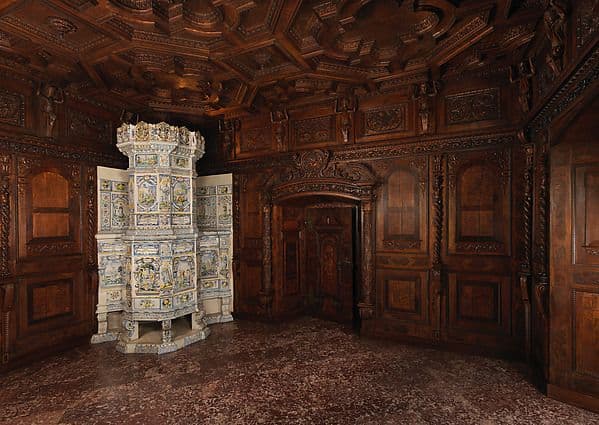
The Metropolitan Museum of Art’s notes on the faience stove made in about 1684–85 for a paneled room from Flims, in Graubünden, sum up the case: stoves were common in Alpine regions, where winter cold lasted for months; they gave continuous radiant heat; and the enclosed fire conserved wood and removed the danger of smoke and sparks that came with open fires. That stove was made in Winterthur, an important Swiss center for faience, and is painted with Old and New Testament scenes. Farmhouse stoves were usually plainer, often with a bench, the Ofenbank, built against them.
Paneled walls and wooden ceilings
The Stube was lined in wood, which helped hold the stove’s warmth in the room. Among the examples in this library, walls range from plain boards in medieval farmhouse rooms to framed, carved and inlaid paneling in castle and manor rooms, and ceilings range from boards and exposed beams to coffers. The Tyrolean farmhouse Stube of 1830 has a beamed ceiling over paneled walls; the Renaissance Stube from Thierburg, now in Innsbruck, combines carved and inlaid wall paneling with a coffered ceiling.

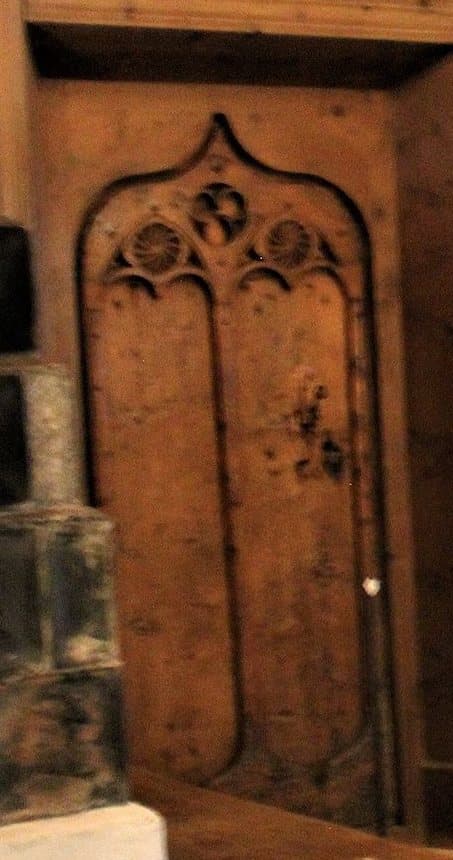
Farmhouse rooms were generally of local softwood. A prized choice is Swiss stone pine (Pinus cembra), called Zirbe in Austria and Arve in Switzerland: a light, soft, aromatic wood that is easy to work and carve, used for paneling and furniture. Indoors it is usually left untreated so as not to seal in the scent. Modern marketing often attaches health claims to it, but the small study usually cited has not persuaded courts in Austria and Germany, which have barred such claims in advertising.
The corner bench and the Herrgottswinkel
Much of the Stube’s furniture was built in. A bench fixed to the wall ran along one or more sides of the room, typically meeting in a corner where the table stood. The Tiroler Volkskunstmuseum shows such a bench, with its paneling, from the Johannser-Hof near Villanders in the Eisack Valley, dated to about 1500.

Above the corner bench is the Herrgottswinkel, the Lord God’s corner: a crucifix, often with a statue of the Virgin or pictures of saints, candles, a palm branch or a bunch of blessed herbs. It is often in the corner opposite the stove, placed so that it can be seen on entering and from the table. The custom spread in Catholic homes from the 16th century; families sat on the bench beneath it for household prayers, and it is still common in inns in southern Germany and Austria. In Protestant regions a shelf with the Bible and devotional books often took its place.
Painted furniture and chip carving
Much of the color came from furniture. At the Appenzell Folk Museum in Stein, Switzerland, a farmhouse room is furnished with an 18th-century chest, bed and cupboard decorated with traditional Appenzell furniture painting. In Upper Bavaria, painted farmhouse furniture had become close to an industry by the mid-19th century: cabinets from the area around Bad Tölz, decorated with rose motifs or saints, sold well beyond the region, helped by King Maximilian II’s promotion of folk art.
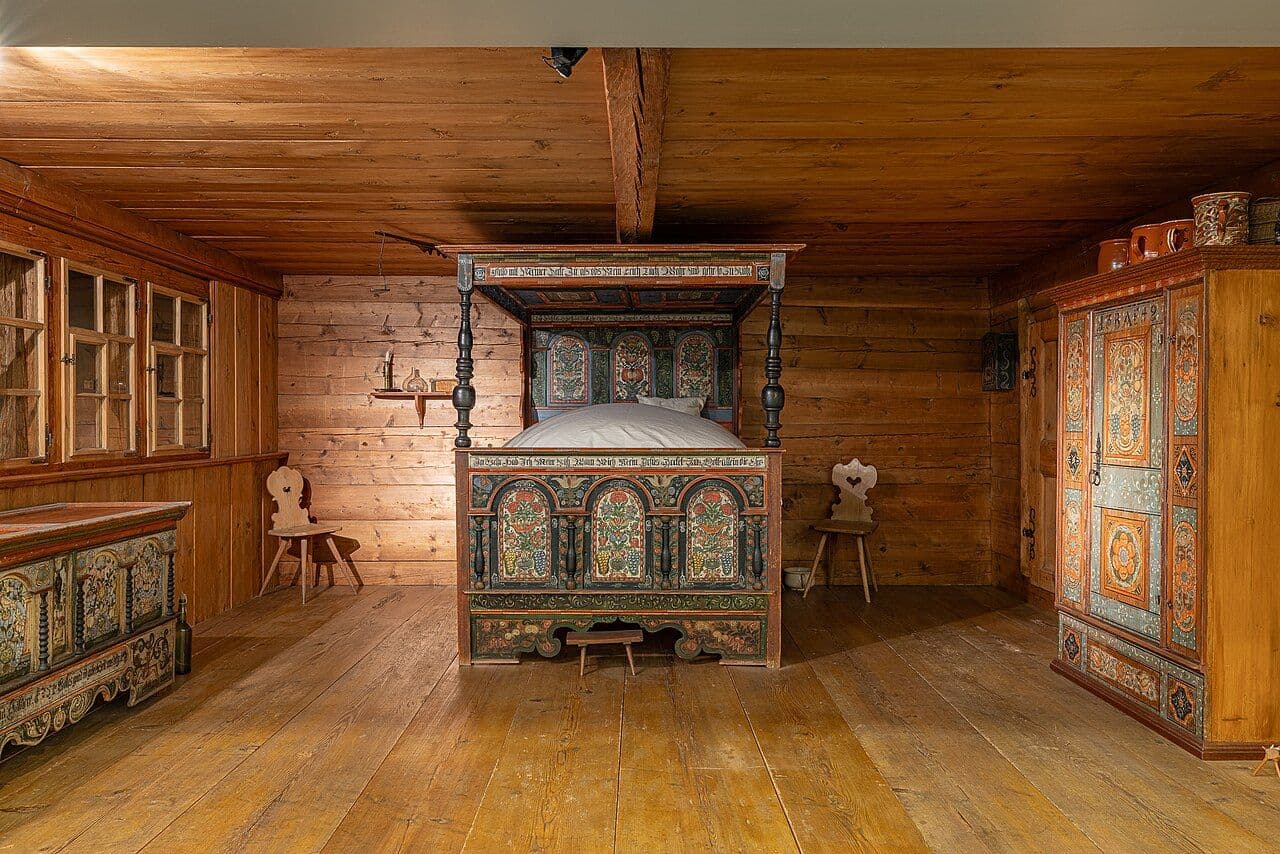
The usual German term, Bauernmalerei, needs care. It now refers mainly to folkloric painting in the old manner, taken up by hobby painters and the souvenir trade since the second half of the 20th century; German art dictionaries rarely give it an entry of its own and discuss the historical work under furniture painting. Chip carving (Kerbschnitt), in which a knife removes small, usually triangular chips to build up geometric patterns, belongs to the folk art of many countries, not only the Alps: the bench with a chip-carved back in this library comes from the Lüneburg Heath in northern Germany. In grander Alpine rooms the equivalent ornament is inlay, as in the Thierburg and Flims rooms.
Regional variation: Tyrol, Switzerland and Bavaria
The Stube is shared across the German-speaking Alps, but details differ. Historic Tyrol, which the Innsbruck museum defines as North, South and East Tyrol together with Trentino, supplies most of the surviving examples in this library: board-lined rooms, corner benches and stoves, from medieval farmhouse rooms at Dietenheim to Renaissance castle rooms in Innsbruck. In Bavaria the Herrgottswinkel is common in inns as well as homes, and Upper Bavarian painted cabinets such as the Tölz cupboards became a commercial product in the 19th century.
Swiss rooms show a wide range. The Flims Room was the “Rich Room” of a small manor house, the Schlössli, built in 1682 for Johann Gaudenz von Capol; the Met notes that its carving combines local tradition with motifs derived from the Italian Renaissance, and its stove came from Winterthur. The Met describes Grisons, or Graubünden, as a Protestant canton, a reminder that the Herrgottswinkel is a Catholic custom rather than a universal Alpine one. Appenzell, in the northeast, has its own tradition of furniture painting. The word chalet itself comes from the French-speaking western Alps of Switzerland and Savoy, where it first meant a herdsman’s hut.
Historical practice vs. modern chalet style
Chalet style is itself a revival. The Swiss chalet style of the late 18th and 19th centuries took rural Alpine houses as a romantic model and spread across Europe, with facades dressed in wooden balconies and carved ornament. In the United States, Washington State’s historic preservation office notes that A. J. Downing introduced the Swiss chalet to American readers in an 1850 stylebook and that a revival followed in the Arts and Crafts years, popular from about 1900 to 1925. Where Swiss models used heavy timber and log construction on stone bases, American versions applied the decoration to ordinary platform framing, with balconies “highlighted by flat balusters with decorative cut-outs,” a motif drawn from the sawn balcony boards of Alpine houses.
Inside, the Stube had its own revival. In the 19th century, nostalgic “old German” Stuben, with German-nationalist overtones, were fitted into town houses, inns and hotels, and Alpine tourism turned chalets into holiday homes until the word could mean almost any vacation house. Hotel and restaurant Stuben continue that line today, alongside traditional rooms still in use, such as the Brückenwirt’s.

A useful test for a modern chalet room is whether it keeps the logic of the Stube, a warm room organized around a stove, a wall bench and a corner table, rather than simply adding knotty pine and heavy beams. American mountain lodges of log and timber are a separate tradition, covered under Mountain Modern.
Checklist: what reads as authentically Alpine
- One main room lined in wood on the walls and ceiling, in local softwood or stone pine, left plain.
- A tiled or plastered masonry stove as the heat source, with a bench beside it.
- A bench built along the walls, meeting at a corner table.
- In Catholic regions, a Herrgottswinkel above the corner bench, often opposite the stove.
- Color from painted chests, beds and cupboards; chip-carved or simply molded detail in farmhouse rooms, with inlay and coffered ceilings in grander ones.
- For more examples, browse wall paneling and built-ins in the Alpine chalet collection.
Sources and further reading
- The Metropolitan Museum of Art — The Flims Room
- The Metropolitan Museum of Art — Stove, attributed to the pottery of David II Pfau, Winterthur
- Tiroler Landesmuseen — Sammlung des Tiroler Volkskunstmuseums
- Wikipedia (German) — Stube
- Wikipedia (German) — Herrgottswinkel
- Washington State Department of Archaeology & Historic Preservation — Swiss Chalet Revival