Wall Paneling & Wainscoting · Georgian & Colonial Revival
Robert Adam Tapestry Room from Croome Court (1763–71)
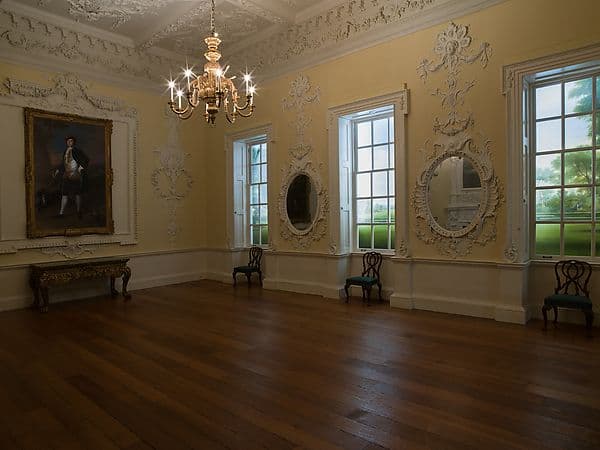
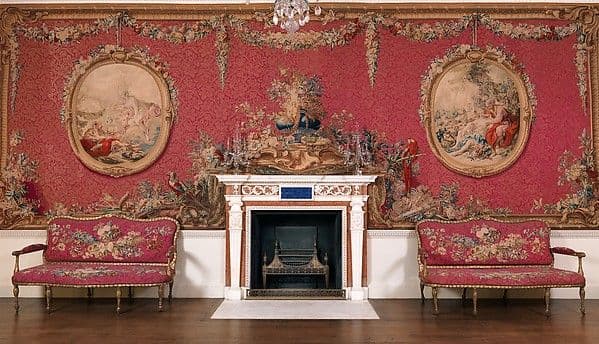
The Tapestry Room from Croome Court in Worcestershire, designed by Robert Adam in the 1760s, with tapestry-covered walls, a coved plaster ceiling and a classical chimneypiece.
Design characteristics
Robert Adam's interiors defined the neoclassical style in Britain, and the Croome Court room is one of the best preserved outside the United Kingdom. Its walls are hung with French tapestries framed by carved and gilded mouldings, below a ceiling of delicate plaster ornament, with a classical chimneypiece. Adam's work relies on thin, precise mouldings and small repeated motifs such as anthemion and husks. Those details translate naturally into Federal and Colonial Revival trim and mantels.
Classification
- Category
- Wall Paneling & Wainscoting
- Motifs
- Adam style, Anthemion
- Date
- 1763–71
- Maker or designer
- Robert Adam
- Recorded medium
- Plaster, pine, mahogany, bronze-gilt, marble, lapis lazuli, steel; wool and silk (22-24 warps per inch, 9-10 per centimeter)
- Dimensions
- H. 27 ft. 1 in. (825.5 cm), W. 22 ft. 8 in. (690.9 cm), D. 13 ft. 10 3/4 in. (423.5 cm)
- Evidence
- Documented historical object
Architectural context
Symmetry, classical proportions and refined raised-panel woodwork. Britain and colonial America · original c. 1714–1830; revival c. 1876–1955.