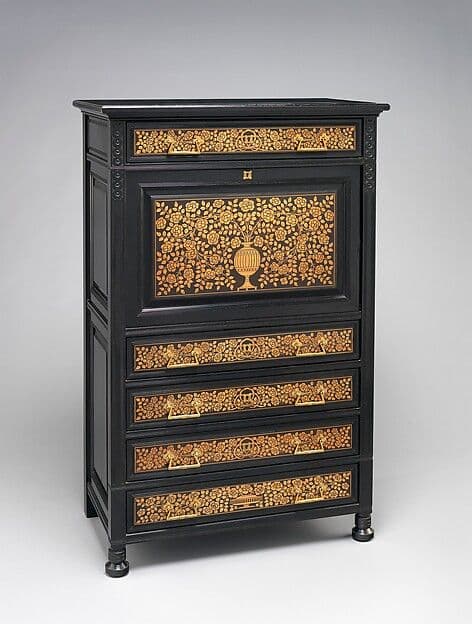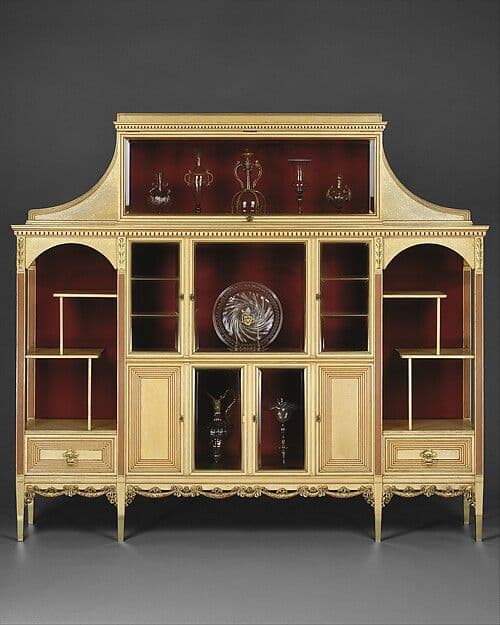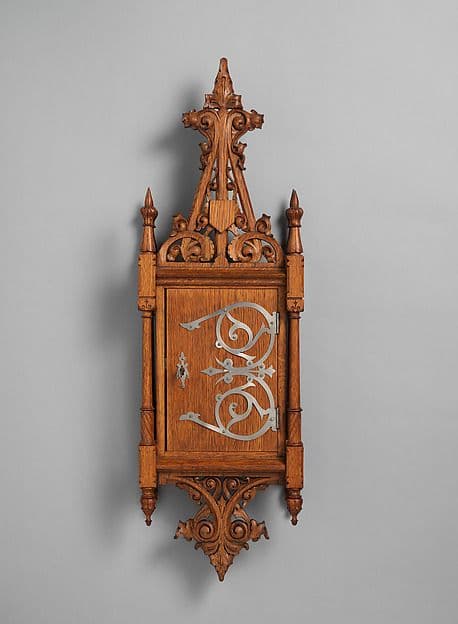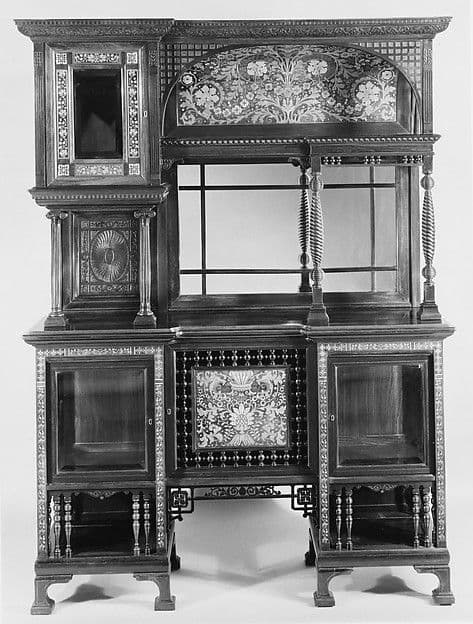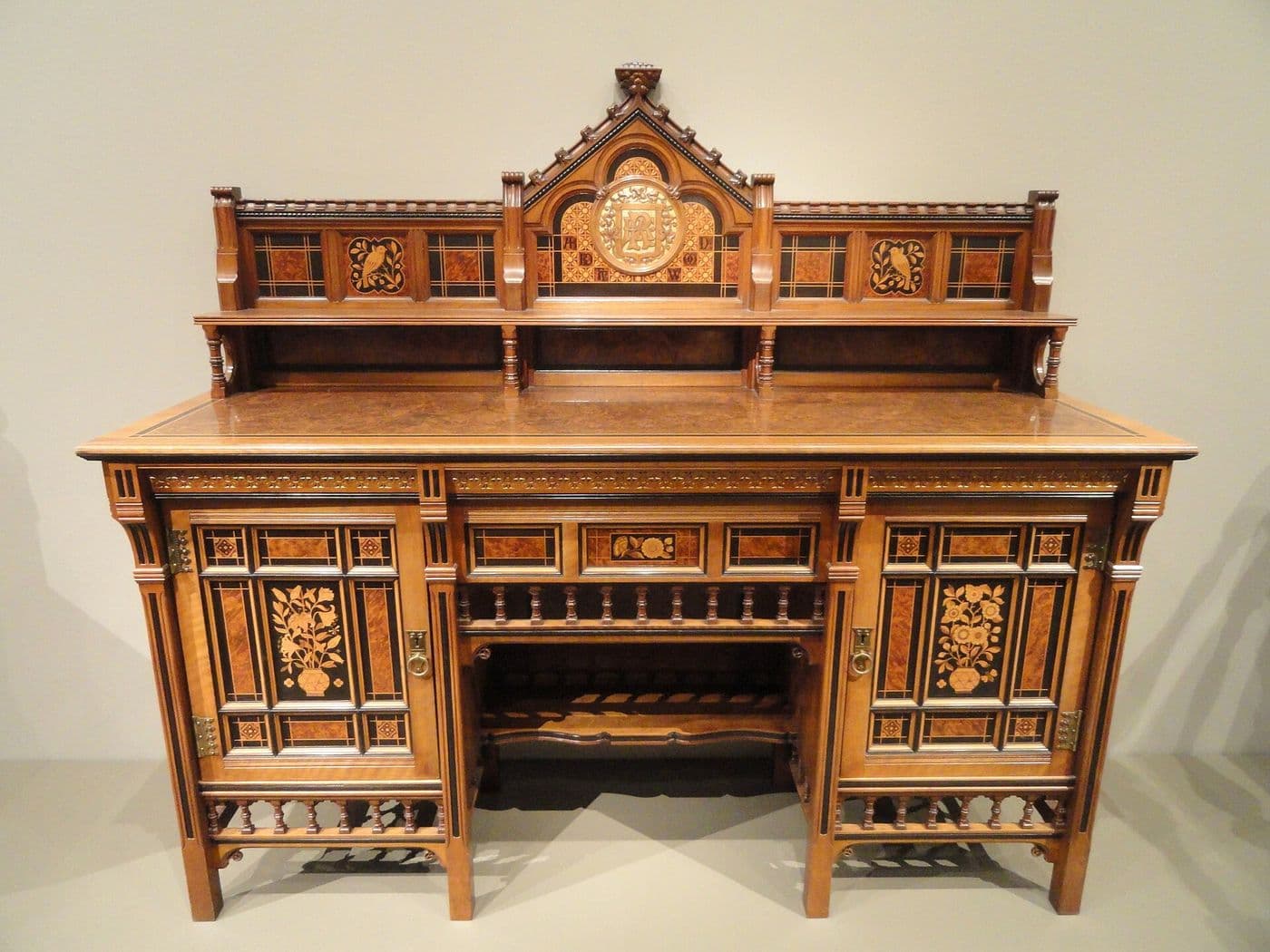
Bruce Talbert Drawing Room Cabinet by Gillow & Co. (1871/72)
A walnut drawing room cabinet designed by Bruce James Talbert and made by Gillow & Co. in Lancaster, England, combining Gothic structure with inlaid panels of ebony, boxwood and thuya.
Bruce Talbert was one of the most influential furniture designers of Victorian Britain, and his book Gothic Forms Applied to Furniture shaped the work of American makers too. This cabinet shows his approach: a rectilinear frame with visible structure, turned colonnettes, and flat panels decorated with inlay rather than deep carving. The center is open beneath a writing surface, flanked by cupboards with geometric inlaid doors. The design suits a home office built-in or a library wall where storage, a desk and display share one composition.
Walnut frame-and-panel with CNC-cut inlay pockets in contrasting veneers; colonnettes turned or CNC-indexed; a natural Signature-to-Heirloom desk wall.
A custom version typically runs $125–$220 per sq ft, shipped finished.
- Style
- Victorian (Queen Anne, Eastlake)
- Element
- Cabinet Doors & Fronts
- Date
- 1871/72
- Maker or designer
- Designed by Bruce James Talbert Scottish, active in England, 1838–1881 Made by Gillow & Company England, 1730–1974
- Materials
- Walnut, ebony, boxwood, thuya, maple, and other woods, gilding, and lacquered brass mounts
- Dimensions
- 147.4 × 167.1 × 52.1 cm (58 × 65 3/4 × 20 1/2 in.); With sled: 172.8 × 193.1 × 76.2 cm (68 × 76 × 30 in.)
- Source
- Art Institute of Chicago
More Victorian (Queen Anne, Eastlake) cabinet doors & fronts · all Victorian (Queen Anne, Eastlake) · all cabinet doors & fronts