Herter Brothers Secretary from the Jay Gould House (1882)
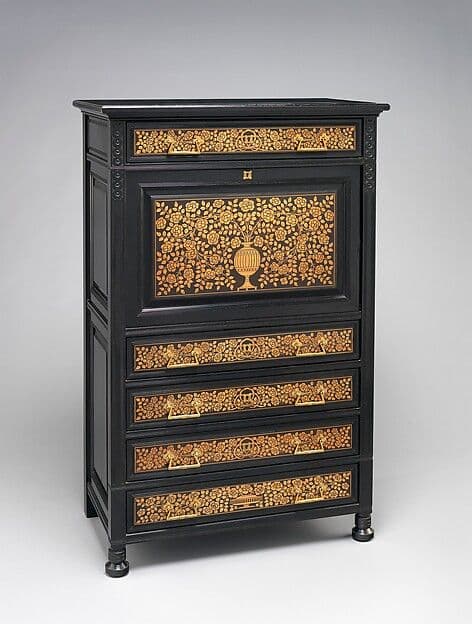
A drop-front secretary made by Herter Brothers in 1882 for railroad financier Jay Gould's New York house, with a dark ebonized case framing bands of light, pictorial marquetry.
Herter Brothers was the most fashionable decorating firm in Gilded Age New York, and this secretary shows why. The case is ebonized cherry, a near-black finish that makes the inlaid panels of lighter wood read like framed pictures. Each drawer front carries its own band of marquetry, and the fall front is treated as a single centerpiece panel. The Aesthetic Movement liked exactly this contrast: a calm, rectilinear box carrying very fine surface decoration. For cabinetry today, the lesson is proportion and contrast. Keep the carcass simple and dark, and let a small number of richly figured or inlaid fronts do the talking. The same approach works on a library wall, a bar cabinet, or a run of drawer fronts in a dressing room.
Ebonized maple or cherry fronts with CNC-cut inlay pockets filled with contrasting veneer; a Signature version can use laser-cut veneer appliqué instead of true marquetry.
A custom version typically runs $125–$220 per sq ft, shipped finished.
- Style
- Victorian (Queen Anne, Eastlake)
- Element
- Cabinet Doors & Fronts
- Date
- 1882
- Maker or designer
- Herter Brothers
- Materials
- Ebonized cherry, mahogany, cedar, and brass
- Dimensions
- 54 x 34 1/8 x 19 in. (137.2 x 86.7 x 48.3 cm)
- Source
- The Metropolitan Museum of Art
More Victorian (Queen Anne, Eastlake) cabinet doors & fronts · all Victorian (Queen Anne, Eastlake) · all cabinet doors & fronts